
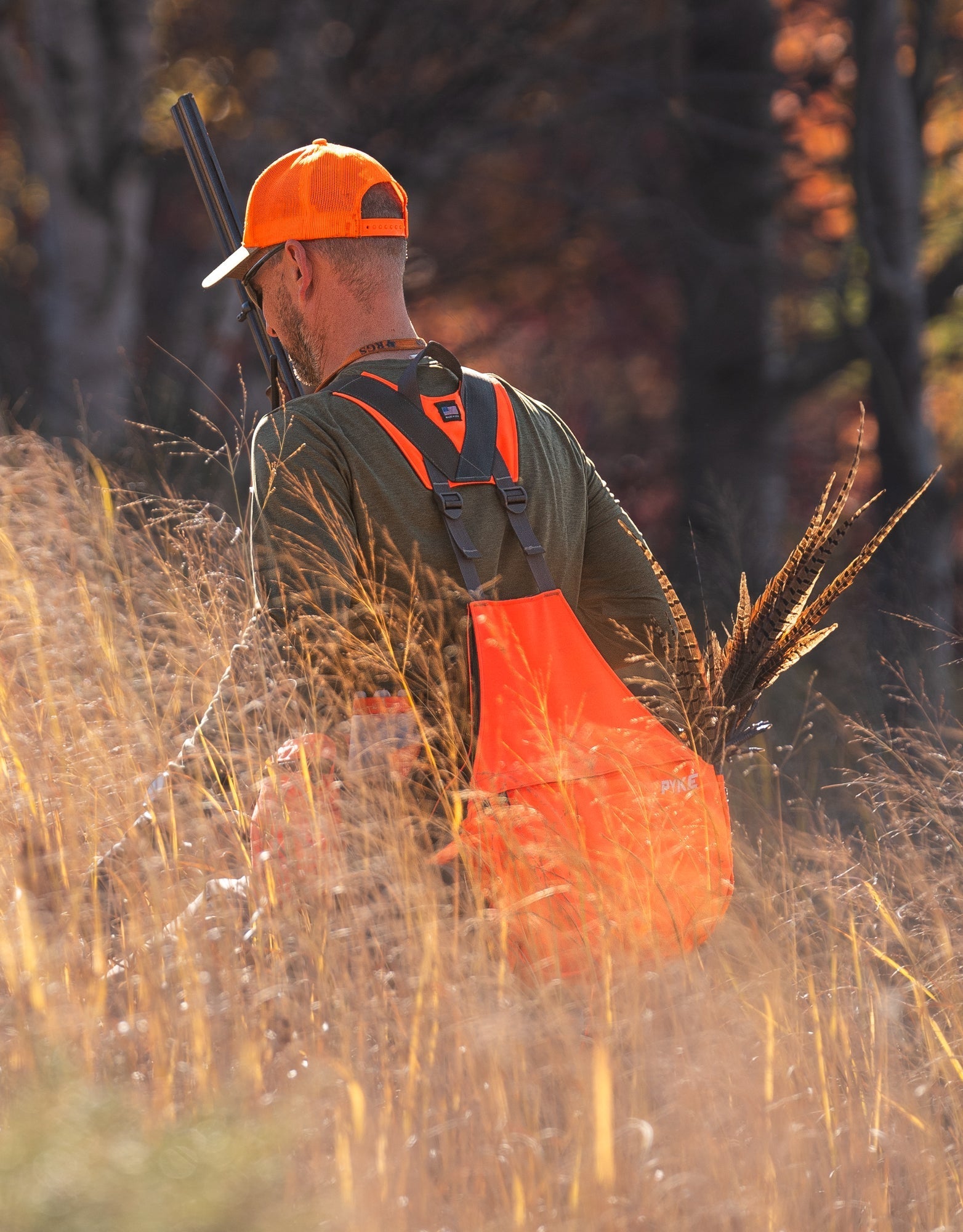

When I made the switch from traditional upland vests to a strap style vest, it really changed the comfort level of my hunts. Sure, it was a basic strap/pouch style vest, but it was more functional and cooler to wear. Once I realized what I had been missing, spending the money on a more advanced vest just made sense. Back at that time, there weren't many options, and I went with the best I knew of. Today, we have a lot of options and with that a lot of decisions to be made. Hopefully this will help you make an informed decision before you choose your next upland strap vest.
And, before you say, "wait, you sell vests, obviously this is a sales pitch", no, this is meant to be a guide that makes you consider all the options and help you make your decision on this journey. This guide isn't meant to be a sales pitch for Pyke vests. I want to walk you through every meaningful decision in buying an upland strap vest, so that when you make your choice, you're making it based on what matters in the field — not marketing language.
There's no piece of upland hunting gear more personal than your vest. Your shotgun might be a family heirloom. Your boots were probably chosen after months of research and significant dollars spent. But your vest is the thing that rides on your back for eight hours straight — it carries your birds, your water, your shells, your camera gear, your dog's first aid kit, and whatever else you talked yourself into bringing. Get it right and you barely notice it's there. Get it wrong and every mile reminds you.
The upland strap vest market has changed dramatically in the last 6 to 8 years. What used to be a simple canvas game bag on shoulder straps has evolved into a sophisticated load-bearing system with modular accessories, hydration management, and customizable configurations that would have seemed like overkill a decade ago. That's mostly a good thing — but it also means there are now a lot of choices, a lot of competing claims, and a real opportunity to buy the wrong vest if you're not thinking clearly about how you actually hunt.
Start With The Upland Vest You Need, Not What Looks Cool
The single biggest mistake vest buyers make is falling in love with features they'll never use, or buying a minimalist vest when their style of hunting demands more. Before you look at a single product, answer these questions honestly. Don't just look at the latest influencer craze.
How many hours are you typically in the field? A two-hour walk in a local CRP patch or a quick swing though midwest woodcock cover has completely different demands than a full-day chukar hunt on a mountain or a pheasant drive in South Dakota where you're covering miles of grassland before noon. Longer days demand more water capacity, more comfortable weight distribution, and more total storage. Shorter hunts reward a lighter, simpler setup.
Do you run dogs? If you're hunting over pointing dogs or flushers, you're carrying water for them too — not just yourself. A serious dog handler on a warm October day can easily go through a gallon of water between themselves and one or two dogs during a full day. If hydration isn't a design priority in your vest, you'll either limit your time afield or make multiple truck trips. Neither is acceptable.
How much do you carry? Some hunters carry two boxes of shells, a water bottle, and their birds. Others carry shells, two water bottles, a first aid kit for their dog, a Garmin handheld, a rain layer, snacks, and backup gear. The weight you're carrying determines how important the load distribution system is. For light loads, a simple strap design is fine. For heavy loads, a vest with a genuine load-bearing waist belt — one that transfers weight to your hips, not just your shoulders — isn't a luxury, it's a necessity.
What terrain are you hunting? Flat Iowa cornfields and South Dakota grasslands are very different from the steep chukar hills of the Northwest or the rocky draws of the Mountain West. On flat ground, almost any vest will serve you. On vertical terrain, weight distribution and center-of-gravity become genuine performance factors.
The Five Things That Actually Matter in an Upland Strap Vest
Once you know your hunting profile, evaluate every vest on this list — and only this list. Everything else is noise.
1. Shoulder Strap Design and Gun Mount Clearance
This is the most important and most overlooked feature in an upland vest. You're mounting a shotgun hundreds of times over the course of a season, often quickly, on moving birds, with your vest loaded. Thick, padded shoulder straps that ride high on your chest interfere with that mount. Over time, that interference becomes the thing you notice every time a bird flushes.
The best strap vests use thin, flat shoulder straps — closer to a seatbelt than a backpack strap — that lay tight enough on your chest to clear your gun mount cleanly. When you try a vest on, mount a shotgun before you buy. If the strap catches on the stock or slows your mount, that vest is wrong for you regardless of every other feature.
2. Load Distribution and Waist Belt
An empty vest feels great when you try it on in the store or at the trade show. A vest loaded with three roosters, a full water bottle, and a days worth of gear feels very different after six miles. The waist belt is what separates a vest designed for serious hunting from one designed to look good on the cover of a magazine.
A functional load-bearing waist belt transfers a meaningful portion of your vest's weight from your shoulders to your hips — the same principle that makes a good hiking pack so much more comfortable than a school backpack over long distances. This matters most for hunters running big country or carrying heavy loads, but it's the feature most likely to earn your appreciation over the course of a season.
Look for a waist belt that has real rigid padding, genuine adjustability, and some grip — a soft but textured material that prevents the belt from riding up or slipping down under load. A flimsy belt that cinches down over your hips without actually bearing weight is cosmetic, not functional. It may feel comfortable when you try it on unloaded, but over time, that flimsy belt is going to sag on your hips.
Also consider the position of all the accessories relative to the belt. Are things hanging off, flopping around in every direction, or is the weight held securely to the belt system? Not only does this determine how the weight is distributed, but also affects your profile as you move through the woods.
3. Shell Pouch Design
You should be able to reach a shell, reload a chamber, and close your pouch without looking down or having to second guess the security of your shells. That's just common sense in the field. Evaluate every shell pouch against it.
The debate between velcro, magnetic, and zippered closures has real substance to it, and everyone seem sot have a preference one way or another. Velcro is fast but can lose grip over time as it wears out — a real issue after a few hundred cycles and beyond. Magnetic closures are clean and fast but can allow shells to spill if the pouch orientation isn't right for how you move.
Magnets on your upland gear will also negatively affect your GPS devices and your compasses. This is a real safety concern, especially if you rely on your electronics to track your dog or find your way back to the truck. While companies that use them claim otherwise, do your research ahead of time. Trust me, I've tested it out. Zippered pouches are the most secure but the slowest to open under pressure. The ideal one is a pouch that gives you quick access without the failure modes.
Pouch size matters too. A pouch that's too deep means you're fishing for shells at the bottom. One that's too shallow means shells fall out when you bend forward. The sweet spot for most hunters is a pouch that holds roughly a box of shells with the top rounds at or near the lip for easy indexing.
4. Game Bag Capacity and Access
You should be able to stuff a bird in your game bag one-handed, without taking the vest off, having to unstrap anything, or without looking behind you, and without losing ground while your dog is honoring the next point. If you have to stop, unclip something, and use two hands to load a bird, the bag design is working against you.
Capacity is worth thinking about honestly. If you're hunting wild birds, a modest bag is probably sufficient — wild bird limits are hard enough to reach that you'll rarely be carrying more than three or four birds at once. If you're hunting preserve birds or guided hunts where limits come early, you'll want something with genuine capacity that doesn't start riding awkwardly once it's loaded.
Another thing to consider in game bags is how far open they sit with loaded or unloaded. A bit gaping pouch on your back is going to allow debris to collect. Yes, maybe not an issue when you are out in the plains or mountains, but in the grouse woods, its a real pain in the butt.
5. Hydration System
This is where the vest market has improved most dramatically in recent years, and where the gap between adequate and excellent is most significant for serious hunters. If you hunt with dogs in temperatures above 50 degrees — which describes most of September and a good portion of October across the entire upland range — hydration isn't optional, it's paramount.
The questions to ask: How many water bottles does the vest hold, and where? Can you add a hydration bladder? Can you access water one-handed while walking? Are the bottle holders secure enough that you won't lose a bottle in heavy cover?
A vest that can carry at least a full gallon of water — roughly 128 ounces, or several large bottles — gives you meaningful flexibility on a full day hunt with one dog. More is better if you run multiple dogs or hunt in heat.
Understanding the Modular System
Most serious strap vests today are built on a MOLLE or PALS webbing platform — the same attachment system used on military and tactical gear. This allows you to add, remove, and reposition pouches, holsters, and accessories to configure your vest exactly the way you want it.
The appeal is real. A modular system means your vest can be minimal for a quick early-season grouse walk and fully loaded for a three-day South Dakota road trip without buying two different vests.
The downside is complexity. A vest that ships with only a frame and a game bag requires you to buy and configure your own pouches — which means more decisions, more money, and more time before you're ready to hunt. For experienced hunters who have strong opinions about where their shell pouches ride and how they want to carry water, this is fine. For hunters building their first serious vest system, a vest that ships with everything you need, already positioned intelligently, is a significant practical advantage.
When evaluating modular vests, look at what's actually included in the base price and what's sold separately. A vest that appears affordably priced might require several hundred dollars of accessories to reach full functionality.
Weight: What Actually Matters
Vest weight matters more than it should in marketing copy and less than it sounds in real-world use. The difference between a 2.8-pound vest and a 3.5-pound vest is less than half a bottle of water. Once your vest is loaded, you're carrying the same weight regardless of what the empty vest weighed.
That said, weight is a real factor for mountain hunters covering serious elevation gain. For flatland pheasant hunters, it's largely irrelevant. Know which category you're in before letting weight be a deciding factor in your purchase.
What matters more than empty vest weight is loaded balance — how the vest distributes weight once it's full. A heavier vest with an excellent load-bearing system will feel better at the end of a long day than a lighter vest with poor distribution.
The Right Vest for the Right Hunter
After all of this, the real answer is that there is no single best upland strap vest. There is the best vest for how you hunt.
For the hunter who wants to go light — early-season woodcock and grouse in the Upper Midwest, walking tight covers, quick out-and-back hunts — a minimal strap vest with a simple game bag, a couple of shell pouches, and one water bottle is exactly right. Don't overbuy. You'll hate the bulk.
Carrying Out Your Injured Dog We've all seen it. A guy carrying his dog in the pack of his vest. Seems pretty cool, eh? Well, consider carefully. Carrying YOUR dog in an upland vest may not always be a smart idea. First of all, only a very specific sized dog will fit in a vest. Second, you may be putting undo pressure on parts of your dog that could cause further damage or impairment. Don't fall for the hype. After talking with a couple vets, it would seem that there are better ways to get an injured dog out of the field, than carrying it in your game bag. Do your research and take proper care of your dog.
Finally, we need to consider cost. Yep, a good quality vest that is made in the USA, is not going to be "cheap". However, when you consider what $350-$400 is in the grand scheme of things, you aren't talking that much money. Especially when you consider that this vest will likely last you 8 years or more if it has a lifetime warranty. That's a pretty low cost average for a piece of equipment that affects your comfort and mobility. Now days, a pair of good boots will run at least that much and will probably only last half that long. Don't skimp out on a quality vest to save $50-$100. For the average truck owner, you are only spending the same amount as your fuel bill for one road trip West.
OK, maybe a small sales pitch for our vest — But, I buried it at the end. South Dakota pheasants, Kansas quail, Idaho and Oregon chukar, long days in wide-open terrain — you need a vest built for all-day performance. That means a genuine load-bearing waist belt, full gallon hydration capacity, a large game bag, and shell pouches you can access without thinking about them. This is where the Pyke Hells Canyon Upland Strap Vest was built to perform.
The customizable load-bearing frame and comfort tech belt distribute weight across your hips, not just your shoulders. The extra-large game bag handles a limit of roosters without distorting your profile. Two hybrid shell pouches — Pyke's new design that converts between open access and zippered security — solve the flap-and-velcro problems that plague other vest pouches. It ships complete with two water bottles and holders for a full gallon of hydration, so you're not building out a system before you can hunt. Made in the USA, backed by a lifetime warranty against manufacturer defects.
The best vest you'll ever own is the one you stop thinking about by the third flush of the morning — the one that's just there when you need it, carrying what it needs to carry, getting out of the way when the dog goes on point.